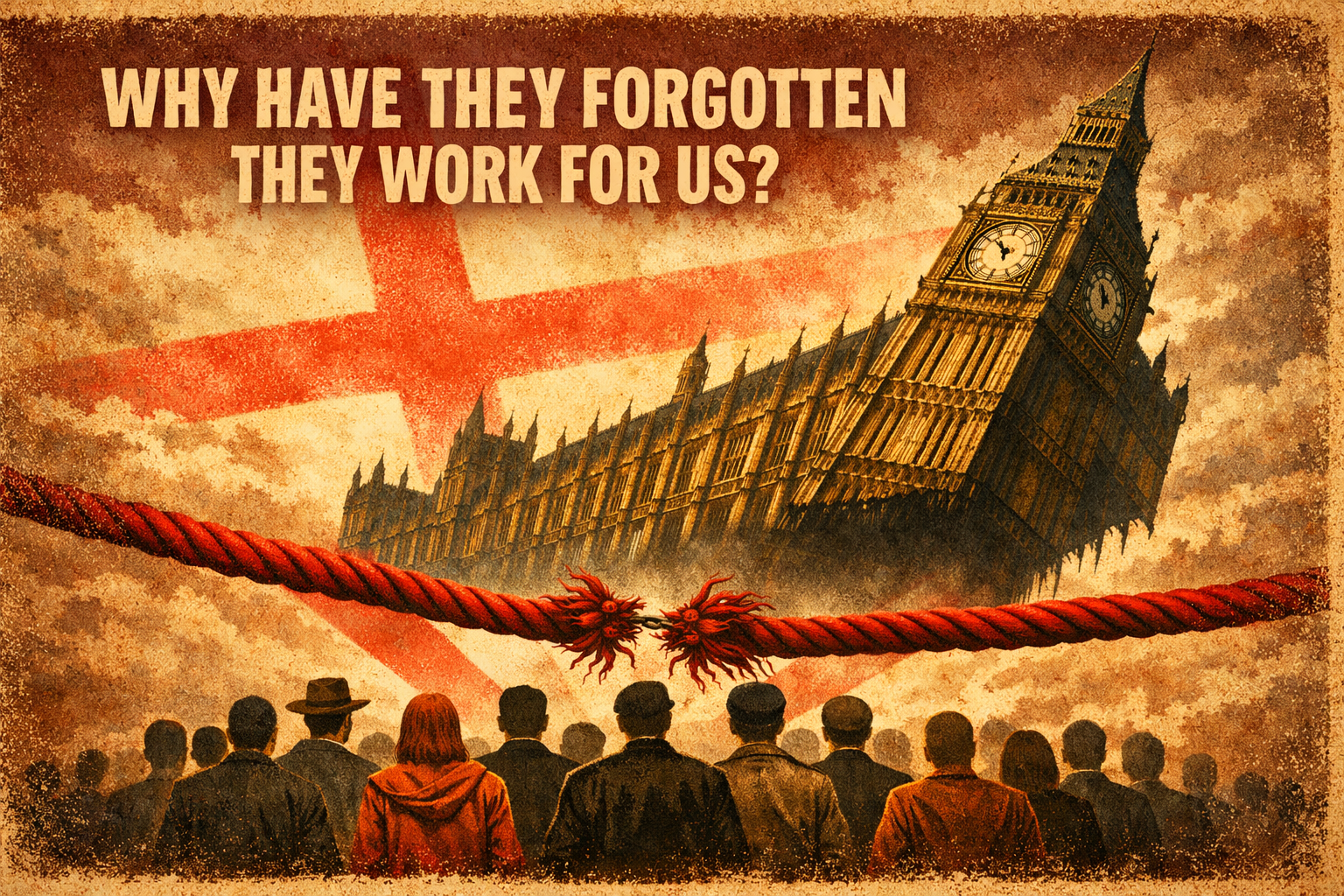
England is being run by people who have forgotten a basic truth: they work for us.
We pay their wages. We fund their pensions. We live with the consequences of their decisions. Yet from grooming gangs to crime, tax and the cost of living, the state behaves as if ordinary English men and women are just background noise and walking direct debits.
This page sets out what the They Work for Us campaign is, why it exists, what we stand for, how we act – and how you can get involved if you feel the same.
What This Campaign Is
An English campaign, not a party
They Work for Us is a campaign, not a party and not a think tank. It sits under England Then and Now as a practical, campaigning arm of English nationalism.
It is English‑led and focused on English interests, but it’s not a formal membership organisation. You don’t need a card or a committee to care about what’s happening to this country. If you share the aims – justice for our own people, proper law and order, fair treatment for working households, and a state that remembers who it serves – this is for you.
Our core idea: they work for us
The phrase is the whole point. MPs, councillors, police chiefs, quango bosses – they are supposed to be public servants. They are not our rulers. They are not a separate caste.
They Work for Us exists to drive that point home, not in a vague “we’re all in this together” way but in a hard, specific way: if they fail to protect us, fail to police properly, bleed us dry and then sneer at us, we will organise, peacefully but seriously, to make their lives and careers more uncomfortable until they listen.
Why Now?
England has been failed on every front
Look at the record.
- Rape gangs: for years, vulnerable English girls were targeted and abused while police and councils looked the other way. The instinct at the top was to protect reputations and “community cohesion”, not children.
- Crime: many towns and cities feel less safe than they did 20 or 30 years ago. Knife crime, street assaults, mass shoplifting – yet the system seems more interested in social media rows than street safety.
- Tax: England carries a heavy, complicated tax burden. Ordinary workers are hammered from every direction while waste and failure are protected.
- Cost of living: food, fuel, rent and mortgages keep rising. People who do everything “right” – work, pay, raise families – are punished while the people responsible talk about “difficult choices” from comfortable positions.
This is not one bad law or one bad minister. It’s a pattern: we pay more, we get less, and we’re told to shut up and accept it.
Decades of watching the same lies
I’ve watched this for nearly forty years.
New governments, same games. Public inquiries that nod and move on. “Lessons will be learned.” “We take this very seriously.” Meanwhile, the same types stay in charge, the same mistakes repeat, and the people who suffer are rarely the ones with a seat in Westminster or a guaranteed pension.
At some point you have to stop treating this as bad luck and start seeing it as a system that is perfectly happy with how things are – as long as you grumble and then carry on paying.
That is why now. Not because the latest scandal is uniquely awful, but because the pattern is too obvious to ignore.
What We Stand For
Justice for our own people
First duty of any serious country: protect your own.
That means:
- Justice for grooming‑gang victims and others failed by the system.
- Exposure and punishment for cover‑ups and cowardice, not polite early retirements.
- A serious national push to stop this ever happening again, not another buried report.
If English nationalism doesn’t start with “we protect our own children”, then it’s not worth the flag it’s printed on.
Law and order that protects us
Law and order should not be a slogan or a tweet. It should mean:
- Visible, hands‑on policing that prioritises real crime, not box‑ticking PR.
- Courts that treat repeat violent and sexual offenders as a serious threat, not “unfortunate cases”.
- A system that worries more about the safety of decent people than the comfort of those who prey on them.
At the moment too many English people feel the opposite: that the state watches them like a hawk for small infractions while turning a blind eye to bigger threats.
Fair treatment for working households
If you work, pay your way and try to raise a family, the state should not treat you as a piggy bank with legs.
We stand for:
- Lower overall squeeze on working English families.
- A serious attack on waste, vanity projects and useless quangos before another penny is taken from people already struggling.
- An economic attitude that sees English people as citizens to be served, not just taxpayers to be milked.
Peaceful, disciplined English action
Finally, this campaign stands for non‑violent, disciplined action.
We are not here to start riots or smash up our own towns. The people we want to reach love it when they can point to a broken window and shout “see, thugs.” We are not playing that game. Our strength is in numbers, discipline and persistence, not in mindless outbursts.
How We Act: Peaceful English Pressure
One‑day English days of action
The main tactic behind They Work for Us is simple:
For one day at a time, as many English men and women as possible withdraw their normal cooperation with the system – peacefully, lawfully, and visibly.
A “Day of English Action” could include:
- People who can doing it booking annual leave or unpaid leave on an agreed day.
- Small businesses closing for the day or donating a visible slice of takings to victim support or campaign groups.
- Retired people and those out of work joining vigils, standing outside town halls and police HQs, or staying off discretionary spending for the day.
- Everyone using that day to email MPs, PCCs and councils, and to flood social media with one clear demand: remember who you work for.
No bricks, no flares, no stupid “civil war” fantasies. Just one 24‑hour block where we show, together, that we are done pretending everything is fine.
Digital and political pressure
Between days of action, we build pressure digitally and politically:
- Coordinated email days targeting MPs, PCCs and councils with clear, tight demands.
- Sharing and amplifying key articles and resources from England Then and Now and other serious writers.
- Using consistent phrases and tags that hammer home the message: They Work for Us, English justice, English action.
This isn’t about spamming inboxes with abuse. It’s about making sure the people we pay cannot pretend they haven’t heard us.
Consumer and economic choices
Our spending is one of the few levers we still control day to day.
So we encourage:
- One‑day “no spend” actions where people cut non‑essential purchases to send a signal.
- Targeted boycotts of brands, councils or institutions that openly support or benefit from policies we oppose.
- Choosing to support businesses and groups that share or respect English concerns.
Again, no vandalism, no threats – just quiet, coordinated refusal to feed parts of the machine that are openly working against us.
What We Are Not
Not a call for violence or chaos
Let’s be crystal clear.
They Work for Us does not support:
- Violence
- Vandalism
- Threats or harassment
- Random confrontations with police or opponents
If someone turns up at a day of action with that mindset, they are not acting in this campaign’s name. We are not handing the state or the media a ready‑made excuse to crack down or smear every English nationalist as a thug.
Not a personality cult or new party
This is not “Darren’s movement” and it’s not a new party with a logo and a membership card.
I’m a writer and organiser who has had enough of watching the same betrayals on loop. The campaign is about a principle – they work for us – and about English people acting on it together. If someone else says it better or organises better, good. This is bigger than any one name.
Not about hating other nations
We are not here to scream about every foreign country or turn every argument into a war over flags abroad.
This is about loving England and protecting English people in England. It’s about saying: our own people come first in our own country. That is normal. That is how every serious nation behaves.
How You Can Join In
Join the campaign list
If you support the idea, the most important thing you can do right now is simple:
Add your email to the campaign list.
Why? Because we can’t coordinate days of action, email pushes or local meet‑ups through wishful thinking. An email list is how we:
- Announce English days of action and other key dates.
- Share new resources and key articles.
- Ask you directly what you’re willing to do and where.
Take simple actions now
Even before a big day is announced, there are small, real things you can do:
- Email your MP using a short, sharp template pointing to grooming gangs, crime, tax and the cost of living and asking what they actually plan to do.
- Share key pieces from England Then and Now and other serious sources instead of just venting into the void.
- Talk to friends and family about the idea of English days of action and peaceful pressure – plant the seed before we ever set a date.
None of this is glamorous. But it is the groundwork for something more serious than just another moan.
Prepare for English days of action
If you already know you’d support a day of action:
- Think about when you could book leave or shuffle shifts.
- If you’re self‑employed, think about whether you’d close for a day or donate a slice of takings.
- If you’re retired, think about whether you’d attend a vigil, stand outside a town hall, or help online.
When we do set dates, the people who have thought ahead will be the backbone.
Questions and Objections
“Will this really make any difference?”
One day, by itself, won’t undo decades of decay. I won’t insult you by pretending otherwise.
But nothing changes while we just complain. The only thing the establishment truly fears is sustained, organised, visible refusal to play along. If thousands – eventually tens of thousands – of English people start acting together, politely but firmly, it becomes harder to ignore.
“Is this legal?”
We are talking about:
- Using lawful leave and lawful protest.
- Choosing how and where you spend your money.
- Writing to your so‑called representatives.
We are not telling anyone to break the law. We are using what is left of our rights as English citizens while we still have them.
“Is this far right?”
Lazy people will call any serious English nationalism “far right” because it saves them from having to think.
This campaign is about:
- Justice for victims of grooming and crime.
- Fair treatment for people who work and pay.
- A non‑violent, law‑aware way of pushing back.
If someone thinks those are “far right” ideas, that says more about them than about us.
Our Principles
English first, not English only
We believe:
- England has the right to put its own people first in its own land.
- That doesn’t mean hating anybody else. It means ending the habit of putting English people last in their own country.
Peaceful but not passive
For too long, we’ve treated “peaceful” as if it means “do nothing.”
Our line is different:
- We stay peaceful. We do not start fights.
- But we do act – together, repeatedly, and in ways that put pressure where it belongs.
Honest about the situation
We are not interested in fantasy. If we criticise the police, councils or Westminster, we do it with facts, figures and real stories.
That matters:
- Because we want to be taken seriously by people who are half‑awake and half‑afraid.
- Because the truth, laid out plainly, is damning enough without embellishment.
What Happens Next?
The roadmap
Roughly, this is the plan:
- Build a serious email list of people who are willing to do more than just nod.
- Publish and share core articles on grooming gangs, crime, tax, cost of living and English nationalism.
- Run smaller “test” actions: email days, no‑spend evenings, digital pushes.
- When the base is ready, announce the first Day of English Action with plenty of notice.
- Learn, adjust, and keep going – one day, one action, one step at a time.
This isn’t a one‑week campaign. It’s about changing how English people respond when the state fails them.
How to stay in touch
To stay plugged in:
- Join the email list – this is the main channel.
- Follow England Then and Now on Substack, YouTube and social for updates and arguments.
- Look out for local meet‑ups or chapters if and when people start them in your area.
Call to Action
They have forgotten they work for us.
They have forgotten that the English are not just tax cattle, not just background scenery, not just people to be shamed and silenced while they run the country into the ground.
They Work for Us is about reminding them – calmly, clearly and repeatedly – that we are still here, we are still paying attention, and we are no longer prepared to sit quietly while our own people are failed.
If that rings true to you, do one simple thing now:
Add your name, add your email, and be ready to act with us.
The time to act is now. England is waiting.