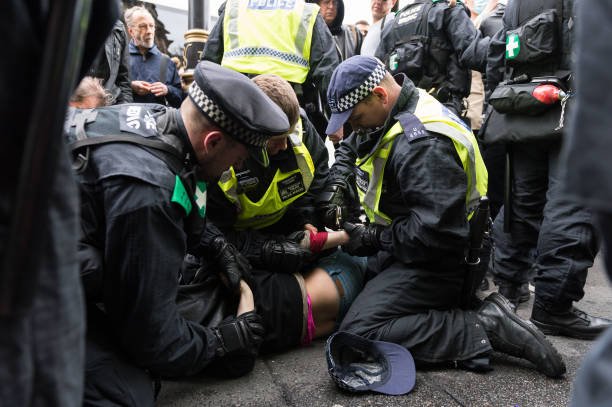
For most of my life, if the government pushed it too far, people got the ump and went out to make a noise about it. That was normal.
Now it feels like the state thinks it decides when we’re allowed to be angry, how loud we can be, and what we’re allowed to carry while we do it.advicenow+1
This isn’t just about a few climate protests or one Home Secretary’s press release. It’s about the way UK protest laws have quietly shifted over the last 40 years, and how the English have started behaving like supplicants, ringing the police to ask if it’s “ok” to protest.
I’ve been watching politics and the news closely since before Thatcher got the keys to Number 10. In that time, I’ve watched The Uni Parties – the whole red‑blue‑yellow‑green circus – promise us change every five years, then use each crisis as an excuse to tighten control.
If we’re serious about England, we need to understand what they’ve done to protest, who let them do it, and what we can actually do – peacefully – to push back.
What UK protest laws actually say, in plain English
Let’s strip away the legal jargon for a minute.
In theory, protest is protected by Article 10 (freedom of expression) and Article 11 (freedom of assembly) of the Human Rights Act. Those rights sit on top of the European Convention on Human Rights.
In plain English, that means you are supposed to be able to gather peacefully with others and say what you think, including about the people running the country.
The Public Order Act 1986 set the basic framework most of us grew up under. It scrapped old common law offences like riot and unlawful assembly and replaced them with statutory offences like riot, violent disorder, affray and so on.
It also gave police powers to put conditions on marches and assemblies – things like the route, the start time, and how long you can stay – if they believe it might cause serious public disorder, serious damage to property, or serious disruption to the life of the community.
You can argue with how those powers are used, but at least the deal was clear: you can protest, but if it looks like it might genuinely kick off or shut down a town, the police can step in with limits.
That’s the compromise most people thought we still had.
What almost nobody outside lawyers and campaigners realised is just how much that compromise has been rewritten in the last few years.
How we slid into the anti‑protest era
When people talk about UK protest laws now, they don’t just mean the 1986 Act. They mean a whole stack of new measures: parts of the Police, Crime, Sentencing and Courts Act 2022, the Public Order Act 2023, and related regulations.
Taken together, these laws do three big things.
First, they let police crack down on protest noise. Under the PCSC Act, officers can impose conditions if a protest’s noise might cause “serious disruption” or have a significant impact on people nearby.
Noise is the point of a protest. Turning volume into a trigger for restrictions turns the whole idea inside out.
Second, they create new criminal offences for things that used to be standard protest tactics. The Public Order Act 2023 – called the “anti‑protest bill” by many – brought in offences for “locking on”, being equipped to lock on, obstructing major transport works, interfering with key national infrastructure, tunnelling, and more.
Liberty’s analysis shows how “locking on” can mean attaching yourself to another person, object or land in a way that causes serious disruption, with penalties including prison and unlimited fines.
Third, they extend suspicionless stop and search around protests. Under the Public Order Act, a senior officer can authorise stop and search in a defined area for up to 24 hours without needing reasonable suspicion, specifically to deal with protest‑related offences.
That’s not a narrow tool aimed at violent disorder. It’s a wide net thrown over people who turn up with the wrong kind of bike lock or banner.
Rights groups like Liberty, Friends of the Earth and JUSTICE have all pointed out that the language in these new UK protest laws is vague and broad, especially around “serious disruption”.groups.
In practice, that gives the state enormous discretion to decide which protests are “acceptable” and which will be treated as a problem to be managed, controlled or shut down.
That’s the anti‑protest era we’re in: where protest is still legal on paper, but in reality is being turned into something more like a licensed activity.
Who is to blame – and how the English went soft
You don’t get to an anti‑protest era by accident.
Successive governments, across The Uni Parties, have pushed these laws through. They’ve used every protest they don’t like as a justification: climate activists in roads, Brexit marches, lockdown protests, you name it.
Each time, they talk about “balancing rights” or “keeping the public safe” – and each time, the bottom line is more power at the centre and less room for ordinary people to show they’re angry.
But we’ve played our part too.
I’ve lost count of the number of stories I’ve seen where people ring the police before a protest asking if it’s “allowed”, what time they can start, and whether they need permission to walk down their own high street.
We’ve gone from a country that used to think nothing of marching or rallying when pushed too far, to a country where people feel like naughty schoolchildren asking the headteacher if they’re allowed to be upset.
Part of that is fear. When you hear about new offences like “locking on”, suspicionless stop and search, and noise being treated like a crime, you start to worry that turning up could get you a record.
Part of it is the way the media talks about protest – as disruption, not democracy. You’re told you’re selfish for blocking a road, even when the alternative is nobody in power listening at all.
And part of it is how hollow our politics has become. When every election is sold as “change” and every government behaves the same, people either switch off or assume protest doesn’t work anyway.
That’s how you end up with a soft, nervous, permission‑seeking public – exactly what a controlling political class wants.
What a serious country would do about UK protest laws
If England behaved like a serious country, we’d look at these UK protest laws and ask one blunt question: who works for whom?
In a serious country, the starting point is simple:
- Protest is normal. It’s not a niche hobby for activists; it’s a basic way the public tells the people they pay that something is wrong.
- The state’s job is to keep the peace, not to keep the public quiet. Conditions are there to prevent real disorder and violence, not to protect ministers and Uni Party front‑benchers from bad headlines.
- Laws are written clearly, with narrow powers and hard limits, so that ordinary people don’t have to be lawyers to know if they can stand in a square with a sign.
The UK protest laws we now have fail that test.
They expand police powers on the basis of elastic words like “serious disruption”, and then quietly lower the threshold for what counts as serious.
They create offences around common protest tactics and objects, and then hand officers suspicionless stop and search in designated zones.
They treat noise – the basic sound of a crowd saying “enough” – as a problem to be reduced, not a sign of a healthy democracy.
A serious country would reverse that trend. It would:
- Put clear limits on protest‑related offences and strip out vague catch‑alls.
- Remove suspicionless stop and search for peaceful assemblies.
- Reaffirm in law that protest is a fundamental right, not a favour granted when The Uni Parties feel generous.
Most importantly, a serious country’s people would act like the bosses, not the subjects.
What ordinary people can actually do – peacefully
This is where They Work For Us has to earn its name.
We don’t need to wait for The Uni Parties – the whole red‑blue‑yellow‑green club in Parliament – to suddenly discover a spine and roll back these UK protest laws out of the goodness of their hearts.
They’ve spent years tightening them. They will only loosen them if it becomes more trouble to keep them than to scrap them.
That doesn’t mean violence. It doesn’t mean chaos. It means ordinary English people remembering who is supposed to be in charge, and acting like it – calmly but relentlessly.
So what can one voter actually do?
First, get your head around UK protest laws. Not in legal Latin – in plain English. Find a couple of decent guides that explain when police can impose conditions, what “serious disruption” really covers, and where stop and search powers begin and end.groups.friendsoftheearth+2
The more you understand the rules, the harder it is for anyone – police or politician – to bluff you into silence.
Second, stop treating anger as something you need permission for. Yes, some marches have to be notified; fine. But you don’t need emotional clearance from The Uni Parties to be fed up with the state of England.
A static protest outside a council office, a banner on a bridge, a dozen people with signs at a busy junction – these are everyday acts in a country that hasn’t given up on itself.
Third, plug into peaceful organising, not party machines. That’s the whole point of They Work For Us: we are building something that sits above parties, not underneath them.
Councillors, MPs, and would‑be ministers are welcome to support the basic principle – that they work for us and protest is a right, not a nuisance – but this isn’t a fan club for any colour of rosette.
Days of action, local organisers, coordinated letters, and disciplined protests all send the same message: you are employees, not rulers, and we are paying attention.
Fourth, refuse to be scared off by slogans. The Uni Parties talk about “serious disruption”, “guerrilla tactics”, and “protecting public order” because it makes their laws sound like they are aimed at extremists.
In reality, those laws sit on top of ordinary people. If protest was useless, they wouldn’t have tried to pass four different sets of restrictions in just a few years.
Finally, act between elections, not just on polling day. Voting is the bare minimum. The Uni Parties are perfectly happy with a population that shouts at the telly every five years and stays quiet in between.
Serious citizens don’t. Serious citizens show up – calmly, repeatedly, lawfully – and make it clear that the country isn’t a closed shop, it’s a workplace where the staff are accountable.
That’s the peaceful path. Harder than staying home. Easier than pretending nothing can ever change.
Conclusion: stop asking The Uni Parties for permission to have the ump
UK protest laws have shifted from a rough 1986 compromise into a web of powers and offences that hand the state – and The Uni Parties running it – the right to decide when, where and how we’re allowed to show we’re angry.
At the same time, too many English have slipped into a habit of calling authority to ask if it’s alright to be upset, as if protest is a favour we might be granted if we’re polite enough.
That is the mentality of a subject, not a citizen.
The Uni Parties are meant to be our employees. We pay them. We lend them power on the understanding that we can take it back. They sit in a chamber that only exists because people far tougher than today’s crop refused to accept being told when they could have the hump.
If England is going to be more than a flag on a shirt and a name on a tax bill, that has to change. We have to stop acting like customers complaining about bad service and start acting like owners who expect the rules to match the contract.
We have to stop asking permission to have the ump and start reminding The Uni Parties, firmly and peacefully, that they work for us – not the other way round.
Because if we don’t, they will go on writing laws that treat our anger as a crime, and our country will go on feeling less like home and more like someone else’s project.
FAQs
Q1. Are protests still legal under UK protest laws?
Yes. Peaceful protest is still legal and is protected by human rights law, but recent Acts have added new offences and powers that make it easier for police to restrict and criminalise certain protest tactics.
Q2. What did the Public Order Act 1986 change?
It abolished old common law public order offences and created statutory ones, while giving police powers to impose conditions on marches and assemblies to prevent serious disorder, damage or disruption.
Q3. What is the Public Order Act 2023?
It is an Act often described as an anti‑protest bill that introduced new offences like locking‑on, tunnelling and interfering with infrastructure, expanded stop and search powers, and created Serious Disruption Prevention Orders.
Q4. Can police stop and search me at a protest without suspicion?
In certain areas and time windows authorised under the Public Order Act 2023, police can stop and search people and vehicles without reasonable suspicion for protest‑related items and offences.
Q5. What can one ordinary voter do about UK protest laws?
Learn your rights, stop asking emotional permission to be angry, join peaceful organising like They Work For Us, take part in lawful protests and days of action, and keep steady pressure on your elected representatives.